
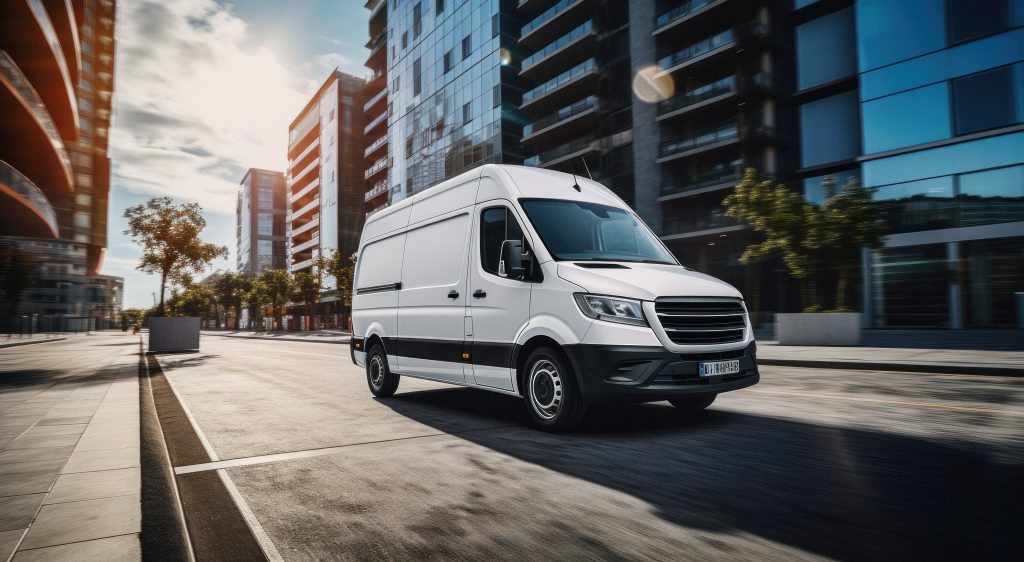
While they may appear similar, they can serve very different operational needs. Understanding how each vehicle performs in real delivery environments, urban, suburban, and regional can help operators make a more informed and financially sound decision.
Each option has clear advantages and trade-offs. Whether you’re handling last-mile deliveries in a crowded city or longer regional routes, knowing the differences in capacity, operating costs, maneuverability, and compliance can help you choose a vehicle that supports your business goals rather than limiting them.
Understanding Sprinter Vans and Cargo Vans
Before comparing the two, it helps to clarify the terminology and why these vehicle categories matter. A Sprinter van is a high-roof commercial van category commonly associated with vehicles that provide substantial interior cargo volume and standing height. These vans are often used for commercial transportation, courier work, equipment delivery, and regional freight.
A cargo van is a broader category of enclosed commercial vehicles designed primarily to transport goods. Cargo vans are available in different roof heights, lengths, and configurations, giving operators flexibility when choosing a vehicle for local and regional delivery. Because the category is broad, operators should evaluate the specific model rather than relying on general assumptions about “cargo vans.”
The distinction is important because not every Sprinter-style van has the same dimensions, payload rating, or operating requirements. Likewise, cargo vans range considerably in size and capability. For a delivery business, the right choice should be based on the actual freight, routes, mileage, and operating costs rather than the vehicle name alone.
Payload and Cargo Capacity
One of the most important factors when choosing a delivery van is how much weight and cargo volume the vehicle can safely handle. Cargo vans generally provide less interior volume than extended high-roof vans, but their capacity can be sufficient for many local delivery operations. They are well suited to packages, small pallets, retail goods, supplies, and other relatively compact freight.
Sprinter-style vans can offer significantly more interior height and cargo volume, particularly in high-roof and extended-wheelbase configurations. This can be valuable when transporting bulky items, stacked packages, equipment, or freight that needs to be loaded vertically. Operators who frequently handle tall freight or multi-piece commercial shipments may benefit from the additional space.
However, more space does not automatically mean greater profitability. A larger vehicle can increase purchase price, fuel consumption, maintenance costs, and operating complexity. If most of your loads are relatively light, paying for additional capacity may not provide a meaningful return. Operators should compare both payload capacity and actual cargo volume with the freight they expect to carry. For a broader overview of cargo van work and freight types, see Cargo Van Work Guide
What Matters More: Payload or Cargo Volume?
These two measurements are not interchangeable. Payload refers to how much weight the vehicle can carry, while cargo volume refers to the amount of physical space available inside the cargo area. A load may take up most of the available cargo space without being particularly heavy, while another shipment may occupy relatively little space but exceed the vehicle’s safe payload capacity.
Before accepting a load, operators should consider total freight weight, number and size of packages or pallets, available cargo floor space, interior height, axle and vehicle weight limitations, and any equipment carried in the van. Matching the vehicle to the actual freight profile can help prevent both underutilized capacity and overloaded vehicles.
Fuel Economy and Operating Costs
Fuel is one of the most important variable expenses for a delivery business, particularly when a vehicle travels thousands of miles each month. Smaller cargo vans can have an advantage when routes involve frequent stops, urban driving, and relatively light loads. Their smaller dimensions can also make them easier to operate in congested areas.
Larger high-roof vans may offer advantages on longer routes because of their greater capacity and, in some configurations, diesel power. However, fuel economy varies significantly by vehicle, engine, load, speed, weather, and driving conditions. Operators should evaluate fuel economy together with purchase price, insurance, maintenance, tires, and expected annual mileage. For a deeper look at route profitability and operating cost calculations, see Cargo Van Route Planning & Profitability
For detailed fuel-economy information, operators can refer to the EPA’s Fuel Economy Guide:
A Simple Operating-Cost Comparison
Rather than comparing vehicles based only on miles per gallon, calculate an estimated cost per mile. A basic calculation can include:
Fuel cost per mile + maintenance cost per mile + insurance cost per mile + vehicle payment/depreciation per mile = estimated operating cost per mile
This gives an operator a more realistic basis for deciding whether additional cargo capacity is worth the expense.
Maneuverability, Clearance, and Driver Experience
Vehicle dimensions can have a major effect on daily delivery operations. If your routes involve dense urban areas, narrow streets, tight loading zones, or frequent parking, a smaller cargo van can be easier to operate. Cargo vans generally offer a lower overall profile and smaller footprint than extended high-roof vans, making them practical for drivers who regularly make numerous stops in urban and suburban areas.
High-roof Sprinter vans provide significantly more standing room and interior space, which can improve loading and unloading efficiency. However, their greater height and length can create challenges in certain environments. Drivers should pay attention to parking garage height restrictions, loading dock access, bridge and clearance limitations, turning radius, overall vehicle length, residential street access, and parking availability.
Licensing, GVWR, and DOT Compliance
Vehicle selection can also affect an operator’s regulatory responsibilities. One important consideration is the vehicle’s Gross Vehicle Weight Rating (GVWR). Federal commercial motor vehicle requirements can apply based on factors such as vehicle weight, whether the vehicle is used in interstate commerce, and the type of operation.
For certain commercial operations, vehicles with a GVWR of 10,001 pounds or more can fall under additional federal requirements. Operators should not assume that a vehicle is exempt simply because it is a van or because it does not require a CDL. Requirements can vary depending on the operation and jurisdiction, so operators should verify their current obligations before beginning commercial operations.
For additional safety and vehicle classification information, National Highway Traffic Safety Administration National Highway Traffic Safety Administration (NHTSA) provides helpful resources. The Federal Motor Carrier Safety Administration provides guidance through its USDOT number requirements.
Maintenance, Repair Access, and Parts Availability
Long-term maintenance is another important difference between vehicle types. Many traditional cargo vans benefit from broad service availability. Routine work such as oil changes, brake service, tire replacement, and general repairs can often be performed by a wide range of commercial vehicle service providers.
Some larger or more specialized vans may require technicians with specific diagnostic equipment or experience with particular powertrains. Depending on the vehicle and location, this can affect repair costs and downtime. For an independent operator, downtime has a direct financial impact. Before purchasing a vehicle, consider availability of qualified repair shops, typical parts availability, tire and brake costs, preventive maintenance requirements, warranty coverage, expected annual mileage, and potential downtime.
Which Is Better for Local Delivery?
For operators focused primarily on local delivery, a traditional cargo van can be an attractive option. Local routes often involve multiple stops per day, urban and suburban driving, frequent parking, shorter delivery distances, smaller shipments, and same-day or scheduled deliveries. In these situations, maneuverability and operating simplicity can be more valuable than maximum cargo volume.
However, the right choice ultimately depends on the freight being transported. A local operator regularly handling bulky equipment or large-volume shipments may benefit from the additional space of a high-roof van.
For a detailed comparison of local vs. regional delivery models, see Local vs Regional Delivery Guide
Which Is Better for Regional Delivery?
Regional delivery can change the equation. Longer routes typically place greater importance on cargo capacity, highway fuel efficiency, driver comfort, storage volume, payload requirements, vehicle reliability, and the ability to carry larger shipments. A larger high-roof van may be more suitable when the operator regularly transports bulky freight or needs additional interior space.
However, regional routes also create more miles, which can increase fuel consumption, tire wear, maintenance requirements, and exposure to vehicle downtime. Operators should calculate profitability based on revenue per trip and total operating cost, rather than simply comparing the amount paid for each load.
How to Choose the Right Van for Your Delivery Business
There is no single vehicle that is best for every delivery operation. Before making a purchase, evaluate your business using the following questions:
- What type of freight will you carry?
- How much cargo space do you actually need?
- Where will you operate?
- How many miles will you drive?
- What is your realistic operating cost per mile?
- What are the vehicle’s actual weight ratings?
- What regulatory requirements apply to your operation?
Cargo Van vs. Sprinter Van: Quick Comparison
| Factor | Cargo Van | Sprinter Van |
|---|---|---|
| Cargo volume | Moderate | Generally higher |
| Interior height | Varies | Often higher |
| Urban maneuverability | Generally easier | Can be more challenging |
| Parking access | Generally easier | More height/length restrictions |
| Bulky freight | More limited | Better suited |
| Local multi-stop routes | Strong fit | Can work, depending on route |
| Regional freight | Suitable for lighter freight | Often better for larger-volume freight |
| Maintenance access | Often broad | Can vary by vehicle |
| Operating cost | Often lower | Can be higher |
| Best fit | Local and moderate-volume delivery | Larger-volume and longer-distance delivery |
Choosing Based on Profitability, Not Just Vehicle Size
One of the most expensive mistakes a new delivery operator can make is selecting a vehicle based solely on its maximum cargo capacity. A larger van may look like the safer or more flexible choice, but extra space does not automatically translate into higher revenue. It creates additional earning potential only when the operator has consistent access to freight that genuinely requires that capacity.
For example, a Sprinter van may be better suited to bulky freight, higher-volume loads, or longer regional routes. However, if most available jobs involve small parcels, local multi-stop delivery, or locations with limited parking and height clearance, the added capacity may go unused. In that situation, the larger vehicle can bring higher purchase, fuel, insurance, maintenance, and operating costs without generating enough additional income to justify them.
The most profitable choice is usually not the biggest vehicle available. Instead, it is the vehicle that matches the type of freight being offered, the distance and frequency of typical routes, and the practical conditions of the delivery area. Urban routes may reward a smaller cargo van’s maneuverability and easier parking, while regional or larger-volume freight may justify the space and interior height of a Sprinter-style van.
The goal is to identify the point where four factors overlap: vehicle capacity, local freight demand, route characteristics, and total operating costs. Before purchasing or leasing a vehicle, operators should review the loads they are most likely to receive, estimate how often a larger vehicle would be fully utilized, and compare the expected additional revenue against the additional cost of ownership. Choosing based on this profitability equation, not size alone, helps build a delivery operation that is both practical and financially sustainable.
Finding Freight That Matches Your Van
Once you have selected the appropriate vehicle, the next challenge is finding freight that matches its capabilities. Operators should consider pickup and delivery distance, deadhead miles, loading and unloading time, fuel consumption, tolls and parking, required equipment, delivery time windows, and return-load opportunities.
A freight marketplace such as CourierBrokers can help shippers and delivery service providers explore available opportunities and find freight that better matches vehicle capabilities.
For operators, the important goal is to build a repeatable process: understand the van’s capabilities, evaluate the complete economics of each load, and prioritize opportunities that fit the vehicle and route.
Conclusion
Sprinter-style vans and traditional cargo vans can both be effective tools for a delivery business, but they serve different operational needs. Cargo vans can be a strong fit for local deliveries, frequent stops, urban routes, and operators who prioritize maneuverability and manageable operating costs. Sprinter-style vans can provide greater interior volume and standing height, making them attractive for larger or bulkier freight and certain regional delivery operations.
The right decision comes down to more than vehicle specifications. Consider your freight, routes, mileage, operating costs, maintenance access, and applicable requirements before investing.